Visit Wilderness
Search for a wilderness as the destination for your next outdoor adventure.
Why Visit Wilderness?
Learn more about the diverse ways in which we benefit from wilderness and threats wilderness areas face today.
1
Search for a wilderness as the destination for your next outdoor adventure.

While wilderness can be appreciated from afar—through online content, television, or books—nothing compares to experiencing it firsthand. Activities like camping, hiking, or hunting allow you to fully enjoy the recreational, ecological, spiritual, and health benefits that wilderness areas offer. These areas provide “outstanding opportunities for solitude or a primitive and unconfined type of recreation,” chances to observe wildlife, moments to renew and refresh, and the physical benefits of outdoor exercise. In many wilderness areas, you can even bring your well-behaved dog.
Learn more about the diverse ways in which we benefit from wilderness and threats wilderness areas face today.
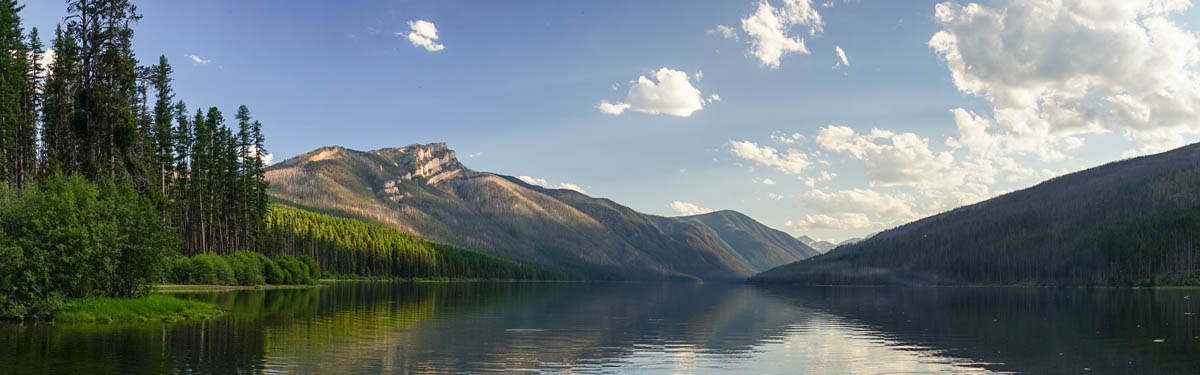
The Mission Mountains are a land of ragged peaks with snow on them most of the year, small active glaciers, alpine lakes, meadows, clear streams that run icy cold, slab-like boulders, vertical cliff faces, and talus slopes. The average elevation is 7,000 feet. In the northern portion, you'll find the terrain less severe and more heavily timbered. The southern portion, however, receives more visitors, primarily around the alpine lakes (most of which do not thaw until mid-June).
The Flathead and Pend Oreille Indians once hunted, fished, gathered berries, and sought visions (they would go into the Wilderness alone, often depriving themselves of food and water, in hopes of seeing a vision) in the rough and broken Mission Mountains. The first organized exploration of this area did not occur until 1922, after which part of the region was set aside as the Mission Mountains Primitive Area in 1931 and then expanded in 1939. The Wilderness you see today stretches for about 30 miles and varies from two to six miles in width.
The dense forest includes pine, fir, larch, and western red cedar. In summer, high basins are painted with a sea of wildflowers. Wildlife lives in abundant numbers in the Missions: elk and deer, black bears and grizzly bears, mountain goats and mountain lions, a few gray wolves, and a wealth of smaller furbearing animals. Approximately 50 species of birds have been identified, including bald eagles. A small population of fish is generally confined to the lakes.
About 45 miles of maintained trails are used almost exclusively by backpackers, the terrain being generally unsuitable for horses. Few of the trails are easy, and many are tremendously steep. There is no overnight camping at Glacier, Upper or Lower Cold Lakes.
The area shares its entire western and southern boundaries with the Flathead Indian Reservation. A permit must be obtained from the Confederated Salish and Kootenai Tribes to enter the Mission Mountains Tribal Wilderness
How to follow the seven standard Leave No Trace principles differs in different parts of the country (desert vs. Rocky Mountains). Click on any of the principles listed below to learn more about how they apply in the Mission Mountains Wilderness.
For more information on Leave No Trace, Visit the Leave No Trace, Inc. website.
Digital and paper maps are critical tools for wilderness visitors. Online maps can help you plan and prepare for your visit ahead of time. You can also carry digital maps with you on your GPS unit or other handheld GPS device. Having a paper map with you in the backcountry, as well as solid orienteering skills, however, ensures that you can still route-find in the event that your electronic device fails.
Motorized equipment and equipment used for mechanical transport is generally prohibited in all wilderness areas. This includes the use of motor vehicles, motorboats, motorized equipment, bicycles, hang gliders, wagons, carts, portage wheels, and the landing of aircraft including helicopters.
Date: January 3, 1975
Acreage: 75,588 acres
(No official title, designates Fish and Wildlife Service wildernesses) - Public law 93-632 (1/3/1975) Designation of wilderness areas within the National Widlife Refuge System
For more information (To download or see all affected wilderness areas) visit our law library for 93-632 or legislative history for 93-632 for this law.
People who volunteer their time to steward our wilderness areas are an essential part of wilderness management. Contact the following groups to inquire about volunteer opportunities. Groups are listed alphabetically by the state(s) in which the wilderness is located.