Visit Wilderness
Search for a wilderness as the destination for your next outdoor adventure.
Why Visit Wilderness?
Learn more about the diverse ways in which we benefit from wilderness and threats wilderness areas face today.
1
Search for a wilderness as the destination for your next outdoor adventure.

While wilderness can be appreciated from afar—through online content, television, or books—nothing compares to experiencing it firsthand. Activities like camping, hiking, or hunting allow you to fully enjoy the recreational, ecological, spiritual, and health benefits that wilderness areas offer. These areas provide “outstanding opportunities for solitude or a primitive and unconfined type of recreation,” chances to observe wildlife, moments to renew and refresh, and the physical benefits of outdoor exercise. In many wilderness areas, you can even bring your well-behaved dog.
Learn more about the diverse ways in which we benefit from wilderness and threats wilderness areas face today.
This magnificent region pays tribute to the Wilderness-loving Supreme Court justice who often explored the area on foot.
It lies bordered to the west by Mount Rainier National Park, with Norse Peak and Goat Rocks Wildernesses just to the north and south, respectively. Non-Wilderness roads drive into the area from the north, up Bumping River to a non-Wilderness central section around Bumping Lake.
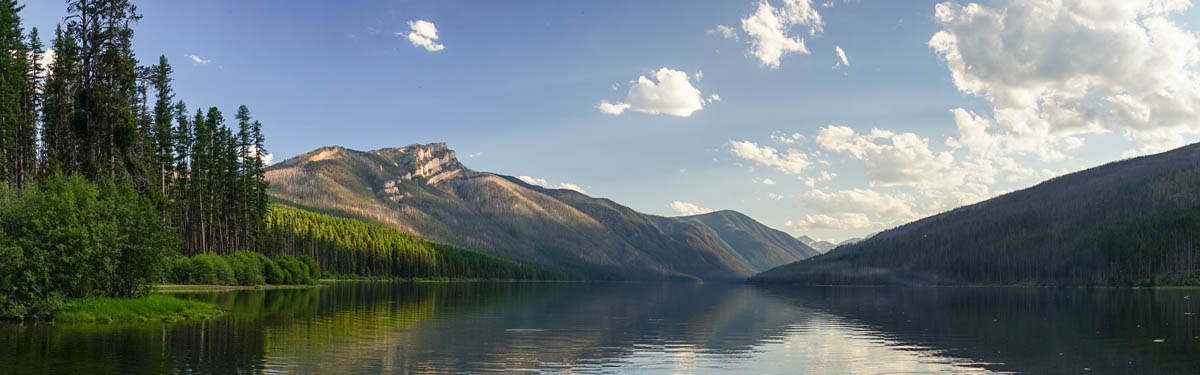
From the lake, the wild terrain rises west and east to high, broad ridges capped with rock summits.
Subalpine meadows and thick old-growth forestland of fir, hemlock, and cedar distinguish the lower elevations. Beyond the east ridge, the land descends to open ridges and tall ponderosa pine.
The southern portion of the Wilderness spreads out into a large park-like plateau, where the forest thins and 59 lakes lie among another 200 or so ponds and pools.
You may see members of large herds of elk and mule deer, who reside here with fishers and foxes, mountain goats and grouse.
As much as 120 inches of precipitation per year drowns the western side of the area, while the eastern side may get as little as 20 to 24 inches. Snow usually starts to fall by November, and often lingers in patches up high until midsummer.
Sixty-six trails crisscross the Wilderness for a total of about 250 miles, providing access to just about everything the Wilderness has to offer.
All but two trails are open to horsepackers (the exceptions being the Spring Trail and the Goat Peak Trail). Indeed, the land may be best appreciated from a saddle.
The Pacific Crest Trail (PCT) traces the western ridge and rambles across the southern plateau for a total of 13.5 miles.
How to follow the seven standard Leave No Trace principles differs in different parts of the country (desert vs. Rocky Mountains). Click on any of the principles listed below to learn more about how they apply in the William O. Douglas Wilderness.
For more information on Leave No Trace, Visit the Leave No Trace, Inc. website.
Digital and paper maps are critical tools for wilderness visitors. Online maps can help you plan and prepare for your visit ahead of time. You can also carry digital maps with you on your GPS unit or other handheld GPS device. Having a paper map with you in the backcountry, as well as solid orienteering skills, however, ensures that you can still route-find in the event that your electronic device fails.
Motorized equipment and equipment used for mechanical transport is generally prohibited in all wilderness areas. This includes the use of motor vehicles, motorboats, motorized equipment, bicycles, hang gliders, wagons, carts, portage wheels, and the landing of aircraft including helicopters.
Date: July 3, 1984
Acreage: 166,603 acres
Washington State Wilderness Act of 1984 - Public law 98-339 (7/3/1984) To designate certain National Forest System lands in the State of Washington for inclusion in the National Wilderness Preservation System, and for other purposes.
For more information (To download or see all affected wilderness areas) visit our law library for 98-339 or special provisions for 98-339 or legislative history for 98-339 for this law.
People who volunteer their time to steward our wilderness areas are an essential part of wilderness management. Contact the following groups to inquire about volunteer opportunities. Groups are listed alphabetically by the state(s) in which the wilderness is located.